Bowl of Rice Cartoon Illustration: A Versatile Asset for Modern Creative Workflows
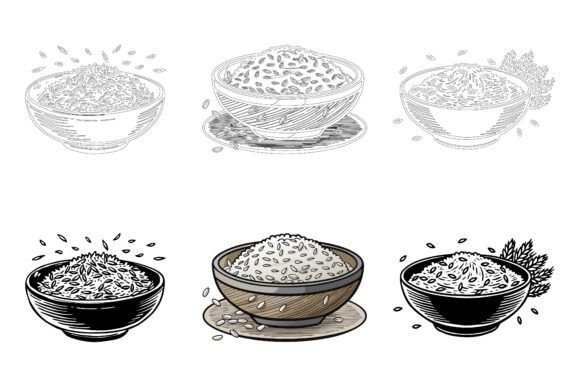
In the digital creative space, an illustration is rarely just a static image. It is a functional component, a building block integrated into broader projects and processes. The Bowl of Rice Cartoon Illustration exemplifies this shift from artwork to asset. At its core, it is a charming, detailed vector illustration of a simple bowl of rice, designed with clarity and a friendly cartoon style. Its true value, however, lies not merely in its aesthetic appeal but in its role as a scalable, editable, and highly adaptable digital file. This makes it a practical resource for professionals who need reliable visual elements that integrate smoothly into their established workflows, from initial concept to final publication.
Where This Illustration Fits into Your Creative Process
Consider the typical stages of a project: planning, execution, and refinement. A versatile asset like the Bowl of Rice Cartoon Illustration can serve a purpose at each phase. During the planning stage, a designer or content creator might be assembling a mood board or a wireframe for a website, app, or marketing campaign. Having a pre-made, high-quality illustration that represents food, simplicity, or Asian cuisine can instantly solidify a visual direction. It acts as a concrete placeholder, moving the project from abstract ideas to tangible visuals much faster than starting from a blank canvas.
In the execution phase, the illustration becomes an active part of the design. Its availability in AI EPS format means it is ready for immediate use within industry-standard software like Adobe Illustrator. For a Mac or Windows user, this compatibility eliminates a common workflow friction point: file conversion or format incompatibility. You can open the file directly and begin integrating it into your layout, whether that's for a print brochure, a web banner, an infographic segment, or an app icon. The neatly organized file and layer structure is a critical feature here. Instead of wrestling with a flattened, messy group of paths, you can easily isolate specific elements—like the rice grains, the bowl shadow, or the steam lines—to adjust or repurpose them without disrupting the entire artwork. This organization supports efficient execution, allowing you to focus on composition rather than technical cleanup.
Integration with Tools, Resources, and Outcomes
The utility of an illustration is defined by how well it interacts with the rest of your toolkit. This EPS set is designed for that interaction. Because it is vector-based, it scales perfectly for any application—from a tiny symbol on a mobile interface to a large poster print—without loss of detail or consistency. This bridges the gap between different media requirements. A marketer might use the same base file for a social media JPEG graphic and a high-resolution trade show display, ensuring brand visual consistency across channels.
Its editability also allows for dynamic interaction with project-specific needs. Changing colors to match a brand palette, modifying the icon to subtly convey a different message (perhaps adding a spoon or changing the bowl's pattern), or even breaking it apart to use elements in a custom pattern are all straightforward processes. This makes the asset a partner to your creative decisions, not a constraint. For educators creating learning materials, or bloggers enhancing their posts, this means the illustration can be tailored to fit the exact tone and context of the content, rather than settling for a generic stock image that doesn’t quite align.
Practical Implementation and Workflow Examples
Let's examine a few concrete scenarios. A small business owner running a food blog or a catering service needs visuals for a new website section about "simple, wholesome meals." They acquire the Bowl of Rice Cartoon Illustration. Their workflow might involve: opening the EPS file in Illustrator, quickly adjusting the bowl color to match their website's earthy theme, exporting a JPG version for a blog header, and then using a simplified version of the icon as a category marker in their navigation menu. The same core asset serves multiple functions, saving time searching for disparate images and guaranteeing visual cohesion.
A freelance graphic designer working on an infographic about global grain consumption could integrate this illustration as a key visual anchor. The detailed yet clear cartoon style makes it suitable for conveying information without being overly complex. They can easily duplicate and modify the icon to show different portions or states, leveraging the organized layers to create a small series of related icons quickly. This contributes to both efficiency and quality control, as the base artwork ensures a consistent style across all derivative graphics.
For long-term use, the perfection in details and consistency embedded in the file becomes invaluable. When you revisit a project months later, or when a new team member needs to work with the assets, the well-structured file is understandable and usable. This protects the quality of your work over time and across collaborations.
Factors for Smooth Integration: Usability, Preparation, and Quality
Successfully integrating such an asset into your routine hinges on a few practical factors. First is preparation: ensuring your software environment can handle the files. The dual-format inclusion (AI EPS and JPG) covers both the editable design stage and the ready-to-publish stage. For users who primarily work in other software, the JPG provides an immediate usable graphic, while the EPS remains the master file for future edits.
Usability is directly addressed by the design decisions behind the illustration. The neat organization means you don't need advanced technical skills to manipulate it. A hobbyist or entrepreneur with basic Illustrator knowledge can still perform meaningful edits. This democratizes the use of professional-grade vector art. The suitability for print, web, symbols, and apps means you can make a single purchase decision for an asset that will serve across multiple project types you might undertake, from business branding to personal hobby projects.
Finally, the focus on quality control and consistency is inherent. By starting with a detailed, consistent vector base, you eliminate the variable of uneven artwork. Any modifications you make stem from a high-quality source, which raises the baseline quality of your entire output. This is particularly important for professionals and creators who manage their own brand perception; every visual element needs to meet a standard, and reliable assets are the foundation of that.
Moving from Acquisition to Application
The journey from considering an asset like the Bowl of Rice Cartoon Illustration to actively using it is short. The key is to view it not as a finished piece, but as a starting point or a modular component. Once acquired, the immediate step is to familiarize yourself with the file structure. Open the EPS, examine the layers, and understand how the illustration is built. This brief exploration will inform how you can best use it later.
Then, align it with an upcoming task. Do you have a newsletter to design? A presentation slide that needs a friendly graphic? A product label concept? Slot the illustration into that real-world need. Experiment with a simple change—a color adjustment, a scale test—to see its flexibility firsthand. This practical test integrates the asset into your workflow naturally, building confidence in its utility. For the productivity-minded user, this process-oriented approach turns a digital purchase into an immediate tool for execution.
The Bowl of Rice Cartoon Illustration, therefore, transcends being merely a cartoon of a bowl of rice. It is a workflow optimization tool, a consistency engine, and a versatile creative partner. It fits into the planning, execution, and refinement stages of projects across disciplines, interacting seamlessly with standard software and diverse media requirements. By offering editability, organization, and multi-format readiness, it enables professionals, entrepreneurs, and creators to enhance their output efficiently while maintaining control over quality and style. The real special collection is the one that works for you, in your process, and this illustration set is designed precisely for that integration.