Evaluating Dumbbells on White Background: A Practical Resource for Graphic Projects
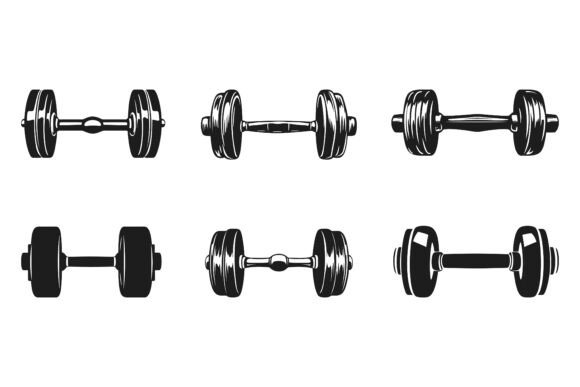
When sourcing visual elements for a design project, the choice often hinges on balancing aesthetic appeal with practical utility. One resource that frequently surfaces in this context is the illustration set often titled The Dumbbells over White Background. At its core, this is a collection of vector-based graphic files depicting dumbbell icons rendered in a clean, minimalist style against a plain white backdrop. Unlike a single static image, it is typically offered as an editable Ai EPS file accompanied by a JPG preview, designed for compatibility with both Mac and Windows systems. For designers, marketers, and content creators, understanding what distinguishes this type of asset and where it fits in the broader landscape of graphic resources is a key step in making an informed selection.
What Makes This EPS Illustration Set Distinct
The description "Hello Welcome to our Special AI EPS Collections" hints at a curated offering. The distinctive value of a set like The Dumbbells over White Background lies not just in the subject matter, but in its construction and delivery. The primary file is an Adobe Illustrator EPS (Encapsulated PostScript) vector file. This format is fundamentally different from a standard photograph or a raster image (like a PNG). Vectors are defined by mathematical paths, meaning they can be scaled to any size without any loss of quality or resolution. This is a critical advantage for applications ranging from a small mobile app icon to a large-scale print poster.
The promised "neatly organized file and layer structure" addresses a common frustration with downloaded graphics. A well-grouped and labeled layer setup within the Illustrator file saves significant time, allowing users to isolate, modify, or delete specific elements—like the dumbbell bars, weights, or the background itself—without tedious manual selection. This speaks directly to the claim of easy editing, color changes, and modifications. When combined with "perfection in details and consistency," it suggests a professionally crafted icon where line weights, curves, and symmetrical details are precise, ensuring the graphic looks polished across all its intended uses.
Comparing Formats and Use Cases
To understand the tradeoffs, it's useful to compare this type of resource with other common options. One alternative is using royalty-free stock photography of actual dumbbells. A photo offers realism and texture, but it is fixed in perspective, difficult to edit fundamentally, and scaling up can lead to pixelation. Another route is using free online icon generators, which might offer a similar dumbbell symbol in SVG or PNG format. While often convenient, these can vary wildly in quality, detail, and licensing terms, and may not come with the organized, editable source file (AI EPS) that professionals require for deep customization.
The The Dumbbells over White Background set positions itself between these poles. It provides the artistic control of a vector with the starting point of a clean, symbolic representation. The inclusion of a JPG file serves a practical comparison purpose: it acts as a quick preview and could be used immediately in low-stakes digital contexts where an editable file isn't needed. However, the true utility is unlocked in the EPS file. Its suitability for print, web, symbols, apps, and infographics stems from the vector foundation. For a fitness app developer needing a suite of consistent health icons, or a print designer laying out a gym brochure where logos need to be enlarged for a cover, this format is inherently more adaptable than a raster image.
Strengths, Limitations, and Best-Fit Situations
The clear strengths of such a collection are its versatility and editability. The white background is not merely aesthetic; it's functional. It allows for immediate placement onto any colored or patterned backdrop without complex clipping work, and it can be easily removed or altered within the layered EPS file. The cross-platform compatibility (Mac and Windows) and the emphasis on a clean structure reduce technical friction, making it accessible to users with intermediate graphic software skills, not just expert illustrators.
However, there are inherent limitations to consider. The graphic is an illustration, a symbolic representation. If a project demands photorealistic detail, texture, or a specific brand of dumbbell, this set would not be the right fit. Its value is in abstraction and clarity. Furthermore, while it is editable, the extent of modification depends on the user's proficiency with Adobe Illustrator or similar vector software. The promise of easy color changes holds true, but more complex reshaping requires skill. Also, as a singular themed set, it solves a specific need—a dumbbell icon—but doesn't address broader requirements for diverse fitness equipment imagery unless purchased as part of a larger bundle.
Decision Factors: When Is This the Right Choice?
Choosing The Dumbbells over White Background becomes a compelling option under several realistic scenarios. It is particularly well-suited for projects requiring a scalable, brand-consistent visual. For instance, a health website creating a custom set of icons for its workout tutorial sections could integrate and color-match this dumbbell to its brand palette effortlessly. An infographic designer needing to depict "strength training" metrics with a clear, repeatable symbol would benefit from the vector's scalability and crisp lines in various chart sizes.
It also fits well in iterative design processes. A marketing team prototyping several concepts for a fitness campaign poster can quickly alter the icon's colors to test different visual themes without starting from scratch each time. The organized layers are a practical boon here, enabling rapid experimentation.
Conversely, readers might need another option if their project context differs. If the need is for a one-time, small-scale web graphic where absolute control over form is unnecessary, a simpler, ready-to-use PNG from a reputable free repository might suffice, saving cost and time. For projects demanding a unique, highly stylized, or artistic illustration that doesn't look like a standard icon, commissioning a custom illustration from a designer would yield a more tailored result, though at a higher investment.
Evaluating the Practical Value in the Marketplace
The marketplace for graphic resources is vast. Sets like this one compete on the basis of quality, usability, and licensing flexibility. The emphasis on "perfection in details and consistency" is a direct response to a common user grievance: finding an icon that looks professionally made at both 16px and 160px. This technical reliability is a key evaluation point. Furthermore, the licensing terms (often implied by the "buy now" call) are crucial. Users should verify that the purchase grants them the broad usage rights claimed—for print, web, apps—without restrictive limitations, which is a typical advantage of buying such assets over using some free alternatives with ambiguous licenses.
From a comparison-aware perspective, the value proposition hinges on the blend of medium quality and high utility. It is not the most unique dumbbell art ever created, nor is it the cheapest possible option. Its practical position is as a reliable, production-ready asset that removes uncertainty. For a user who needs a competent, editable dumbbell graphic tomorrow for a client project, this type of set reduces risk. The tradeoff is potentially a moderate cost versus free resources, and a somewhat standardized look versus a highly unique one.
Moving Toward an Informed Selection
Making a more informed decision involves aligning the resource's attributes with your specific project parameters. Consider the output mediums: will this graphic be used in print at large sizes? The vector EPS format becomes a strong benefit. Assess the need for customization: do you need to match a specific corporate color hex code or integrate the dumbbell into a composite illustration? The editable, layered file is advantageous. Evaluate the time available: does a pre-made, well-structured file save you hours compared to drawing a dumbbell icon from scratch in Illustrator? For many, it does.
Ultimately, The Dumbbells over White Background represents a category of design resource that prioritizes function and flexibility over raw artistic novelty. It is a solution for professionals and enthusiasts who need a dependable visual component that won't break under technical demands and can be adapted to fit into a larger design system. By understanding its format, comparing it to the spectrum of available alternatives, and honestly assessing your own requirements for realism, uniqueness, and control, you can determine whether this type of illustration set is the right tool for your current task or if your search should continue in a different direction.