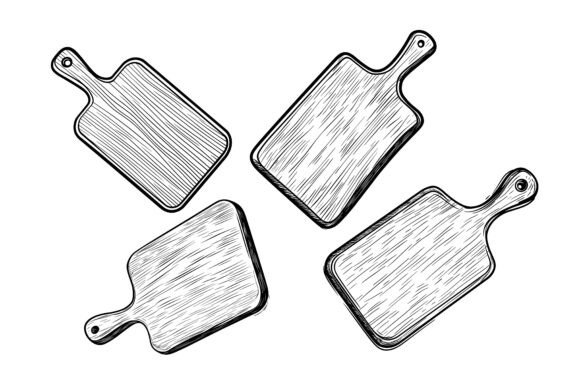
The Artful Utility of a Wooden Cutting Board Illustration
Within the vast world of digital illustration assets, specific images carry a unique weight, blending aesthetic appeal with practical symbolism. A drawing of a wooden cutting board is one such asset. At its core, it is a vector-based digital illustration, typically crafted in Adobe Illustrator, that faithfully represents the texture, grain, and form of this common kitchen object. Its distinction lies not merely in its subject matter but in its execution as a clean, editable, and versatile graphic file, often provided in formats like AI, EPS, and JPG.
What separates a high-quality drawing of a wooden cutting board from a simple stock photo or a basic clip-art icon is the attention to illustrative detail. It captures the organic lines of the wood grain, the subtle shadows along its edges, and the tangible feel of a utilitarian object. This makes it more than a picture; it's a designed component ready for integration into larger creative projects.
Comparing Illustration Formats and Their Applications
When considering visual resources, professionals often evaluate different formats. A photograph of a wooden cutting board offers photorealism and specific context, but it lacks flexibility. Its background is fixed, its colors are locked, and its resolution limits scaling. A 3D model provides immense interactivity and perspective changes but requires specialized software and expertise to render and modify.
A drawing of a wooden cutting board, as a vector illustration, sits in a pragmatic middle ground. The vector nature means the graphic is composed of paths and points rather than pixels. This allows it to be scaled infinitely without any loss of quality, from a tiny app icon to a large billboard print. The editable file structure means the color of the wood can be changed from a light oak to a dark mahogany with a few clicks. The board can be isolated from its background, elements rearranged, or details added to show cracks, knife marks, or food items on its surface. This level of control is its primary strength.
Tradeoffs and Considerations for Different Users
The utility of a drawing of a wooden cutting board depends heavily on the user's end goal. For a graphic designer working on a restaurant's branding, this illustration offers a cohesive, stylized element that can be adapted to match the brand's color palette and used across menus, websites, and packaging. For a web developer creating a cooking blog, it might serve as a perfect, lightweight icon for a recipe category page. For someone designing an infographic about food safety, the clean lines of the illustration can clearly demonstrate proper cutting techniques without visual clutter.
However, there are natural limitations. If a project demands hyper-realistic texture to evoke a specific sensory experience—the feel of rough-hewn wood, the gloss of a polished surface—a photograph or a meticulously textured 3D render might be a more suitable alternative. The vector drawing tends to communicate concept and function over tactile realism. Furthermore, while highly editable, modifying a complex vector file does require basic familiarity with illustration software like Adobe Illustrator or compatible alternatives.
Evaluating Asset Collections and File Structure
Often, a drawing of a wooden cutting board is part of a larger collection, such as an AI EPS set focused on kitchen or food themes. The value of such a collection extends beyond the single asset. A well-organized set with a neat layer structure significantly reduces production time. Instead of hunting for disparate icons, a designer has a coherent library where the wooden cutting board shares the same stylistic treatment with a drawing of a chef's knife, a tomato, or a spice jar. This ensures visual consistency across a project.
Comparing a single downloadable illustration to a subscription-based icon service reveals another decision factor. Subscription services offer breadth and constant updates but can lock users into a recurring fee and a style that may not be exclusive to their work. Owning a dedicated EPS file for a wooden cutting board provides permanent, one-time access to an asset that can be tailored uniquely, potentially offering more creative ownership for long-term brand projects.
Practical Use Cases and Best-Fit Scenarios
Identifying when this type of asset is the right choice involves looking at project requirements. It is particularly well-suited for scenarios where adaptability and repeated use are key.
- Brand System Development: A company creating a line of organic food products might use the illustration as a foundational graphic, altering its colors for different product lines while maintaining a recognizable, artful core symbol.
- Educational Material Creation: An instructor designing printable guides for a culinary class can incorporate the drawing into diagrams, knowing it will print clearly at any size and can be annotated with text and arrows directly in the editable file.
- User Interface Design: For an app focused on meal planning, a simple, recognizable wooden cutting board icon can efficiently denote a "preparation" section or a "tools" category within the interface.
In these cases, the strengths of the vector format—editability, scalability, and clean aesthetics—align directly with the needs. Conversely, for a one-time use in a highly realistic advertisement, or for a project where the designer lacks vector software, alternative resources might prove more efficient.
Key Decision Factors for Selecting Illustration Assets
When researching and comparing options, several practical factors beyond the subject matter itself should guide the choice.
- File Format Compatibility: Ensure the provided formats (AI, EPS, JPG) are compatible with your software and workflow. EPS files offer broad compatibility across both Mac and Windows platforms and with older and newer software versions.
- Layer Organization: A file with logically named and grouped layers drastically simplifies customization, allowing you to modify the wood grain separately from the board's shape, for example.
- Style Consistency: If the asset is part of a collection, assess whether the overall style matches your project's needs and if the drawing of a wooden cutting board harmonizes with other elements you plan to use.
- Licensing and Usage Rights: Clarify the license terms. Most commercial vector assets allow for use in print, web, and apps, but restrictions on resale or redistribution of the file itself are common.
A drawing of a wooden cutting board, therefore, represents a specific tool in the digital creator's toolkit. It is not a universal solution, but for projects requiring a flexible, concept-driven, and professionally crafted visual representation of a fundamental object, it offers a balance of art and utility that can streamline design processes and enhance visual communication. By understanding its distinct properties and comparing them to the requirements of your task, you can make a more informed decision about whether this type of illustrative resource fits your current creative or professional need.